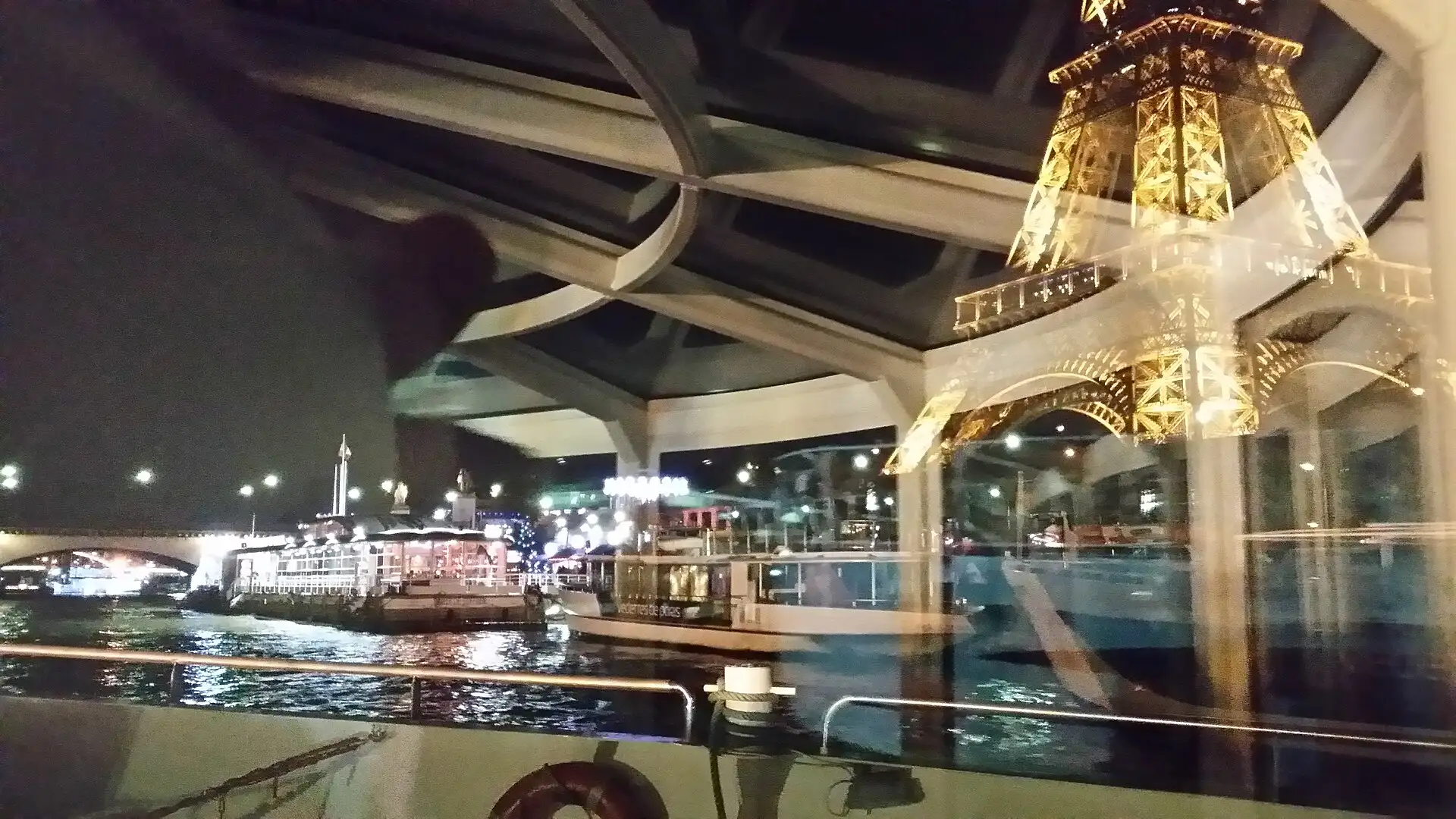
A Seine cruise at night is the same one-hour loop the daytime boats run, transformed by city electricity: floodlit facades from the Louvre to Notre-Dame, bridges lit from below, and the Eiffel Tower doing its five-minute sparkle at the top of every hour. The ticket costs the same €17–25 as a daylight sailing. The only skill involved is timing — because “night” in Paris means 17:30 in December and well past 22:00 in June.
This page covers exactly that: what the illuminations show, the difference between evening, night and dinner formats, month-by-month darkness times, which side of the boat to stand on, and how to get photos that survive the glass. Prices and ratings quoted here come from GetYourGuide listings; check the booking page for the current figure.
What you actually see after dark
The classic route runs east from the Eiffel Tower area past the Grand Palais and Pont Alexandre III — the most theatrical bridge on the river, built for the 1900 World’s Fair and lit so its gilded statues glow — then along the Louvre and the Conciergerie, around the two islands, Île de la Cité and Île Saint-Louis, and back west. At night each of these reads as a stage set: the floodlighting flattens crowds and traffic out of view and leaves only stone and water.
The headline act is the Eiffel Tower itself. After dark it wears steady golden lighting, and for five minutes at the top of every hour it erupts into white sparkle. From the water, with the reflection doubled in the river, this is the single best free spectacle in Paris. Crews know the schedule; most night boats time their turn near the tower to coincide with an hour change when the timetable allows.
Notre-Dame, Pont Neuf — the oldest bridge in the city, finished in 1607 — and the Musée d’Orsay’s clock faces fill the middle of the loop. Commentary matters more at night than by day, because unlit side streets give you fewer clues about what you are passing. If knowing what you are looking at matters to you, pick a cruise with audio guide or live commentary; the cheapest night departures sometimes run without it.
Evening vs night vs dinner cruise: three different products
Operators use these words loosely, so read the departure time, not the product name.
| Format | Typical departure | Duration | Price bracket | What it is |
|---|---|---|---|---|
| Evening cruise | 18:00–20:30 | 1 h | €17–20 | Standard sightseeing loop that may end before full darkness in summer |
| Night cruise | 21:00–22:30 | 1–1.5 h | €17–25 | The illumination cruise proper, often with a drink or music |
| Dinner cruise | 20:30 sailing | 2–2.5 h | €114+ | A restaurant afloat; the lights are the backdrop, not the product |
The aperitif-and-music night cruise at €25 is the strongest pure night format: one drink included, an open bar for extras, and a loop long enough to catch a sparkle. The €17 Bateaux Mouches Evening Lights sailing is the budget play — same monuments, bigger boat, more people. If you want a full meal with the view, that is a different budget and a different page: see the dinner cruise guide.
When does Paris actually get dark?
Book against real darkness, not the word “night” in a product title. Approximate times when the illuminations are fully effective (end of dusk, central Paris):
| Month | Dark from (approx.) | Sensible night departures |
|---|---|---|
| January | 18:00 | Anything from 18:00 |
| February | 18:45 | 19:00 onwards |
| March | 19:30–20:15 | 20:00 onwards |
| April | 21:00 | 21:00 onwards |
| May | 21:45 | 21:30 onwards |
| June | 22:30 | 22:00 onwards |
| July | 22:20 | 22:00 onwards |
| August | 21:30 | 21:15 onwards |
| September | 20:30 | 20:15 onwards |
| October | 19:30 (18:30 late month) | 19:00 onwards |
| November | 17:45 | Anything from 18:00 |
| December | 17:30 | Anything from 17:30 |
All times are approximate and shift through each month; the clock change in late March and late October moves them by an hour at a stroke. The practical rule: in high summer, book the last departure of the evening or accept a dusk cruise — which has its own charm, covered on the sunset cruise page. From October to March, every evening sailing is a true night cruise, which makes winter the underrated season for this format.
Which side of the boat to stand on
The loop is a there-and-back, so both sides eventually get everything — but not at equal distance. Sailing east (downriver monuments to your left as you face forward), the right side of the boat hugs the Left Bank: Musée d’Orsay, the Latin Quarter quays, Notre-Dame’s south face. On the return leg west, the right side gets the Louvre and the Right Bank facades, and the final approach usually presents the Eiffel Tower ahead and to one side depending on the pier.
The honest advice: on a night cruise, skip the seat strategy and stand at the stern rail of the open deck. The stern gives you both banks, the wake doubling the lights, and room to turn. Boats loop around the islands, so anything you miss outbound comes back inbound.
Local tip: board a cruise that departs 20–30 minutes before the top of the hour. That puts you mid-river, usually somewhere between Pont Alexandre III and the tower, when the sparkle starts — instead of still queuing at the pier or already walking to the métro while it happens behind you.
Photographing the illuminations
Night photography from a moving boat through reflective glass is the hardest assignment on the river. What works:
- Shoot from the open deck, not through the salon windows. Glass adds reflections of the interior lighting that no editing removes. If you must shoot through glass, press the lens against it and cup your hand around it.
- Turn the flash off. A flash lights the window and the seat in front of you, not a cathedral 200 metres away. Every lit-up flash on a night boat is a wasted frame.
- Use night mode, brace your elbows on the rail. The boat moves; shutter times stretch. Phones with night mode handle the bridges well if you hold through the capture.
- For the sparkle, shoot video, not stills. The glitter reads as motion; a still frame shows a handful of dots. Ten seconds of video with the reflection in the water is the keeper.
- Best positions: stern rail for wake reflections; the moment passing under a lit bridge for the arch framing the next one.
Manage expectations: the memory outperforms the camera on this trip. Take your frames at the tower and the islands, then put the phone away for a full bridge-to-bridge stretch.
What to wear
The river is reliably colder than the street — moving air plus water. In summer, bring a jacket or sweater for the open deck even after a 30-degree day; in spring and autumn add a scarf; in winter dress as for standing still outdoors for an hour: coat, hat, gloves. The salon below deck is heated on the big boats, so you can always retreat. Sightseeing night cruises have no dress code whatsoever — that is a dinner-boat concern.
Boarding piers and getting there
- Port de la Bourdonnais (Eiffel Tower, Left Bank): the Bateaux Parisiens home pier, a few minutes’ walk from the tower’s legs. RER C Champ de Mars – Tour Eiffel or métro Bir-Hakeim.
- Port de Suffren (Eiffel Tower, Left Bank, slightly upstream): Vedettes de Paris and the small electric boats. Same stations, opposite side of the tower.
- Pont de l’Alma (Right Bank): Bateaux Mouches, the company that has run the river since 1949. Métro Alma-Marceau. Our Bateaux Mouches review covers the fleet in detail.
Arrive 20–30 minutes before departure. Night sailings board efficiently, but the last departure of the evening waits for no one, and quayside signage is easier to misread in the dark. Check the pier name on your ticket rather than following the largest crowd — several operators share each stretch of quay.
Booking a night cruise without overpaying
Night departures rarely need long lead times: midweek, same-day booking usually works. Fridays and Saturdays in July and August are the exception — the last two sailings of the evening fill first, so book those a few days out. Most listings on GetYourGuide cancel free until 24 hours before, which lets you chase a clear-sky forecast at no risk.
Do not pay a premium for the word “night” alone. The monuments are lit by the city, not the operator; a €17 ticket sees the same illuminations as a €25 one, and the difference should buy you something concrete — a drink, music, commentary, a smaller boat. Compare the current numbers on the prices page and the booking walk-through on the tickets guide before you commit.
One booking pattern worth copying: pair a short evening Seine river cruise with dinner on land before or after, rather than paying dinner-cruise prices for banquet cooking. You get the identical view for a fifth of the money and eat wherever you like. The reverse pairing — cruise first at dusk, then a late dinner — works best from May to August, when boarding at 21:30 still means daylight at the pier and darkness by the turn at the islands.
However you slot it into the itinerary, a Seine cruise at night is the version of the river worth planning around: same route, same fare, and a city that has spent a century learning how to light itself for exactly this hour.
What we like
- Every monument is floodlit and the crowds of daytime decks are gone — the same loop looks better after dark
- The hourly Eiffel Tower sparkle is guaranteed entertainment no daytime cruise can offer
- Night tickets cost the same €17–25 as daytime ones — the illuminations are free of charge
- Late departures rarely sell out midweek, so it works as a spontaneous plan
What to watch out for
- In June and July real darkness arrives after 22:30 — early 'evening' sailings are actually dusk cruises
- Open decks get cold on the water even in August; the salon view is through glass
- Reflections and moving boats make phone photos harder than the postcards suggest
- Some budget night cruises skip the recorded commentary, so you sail past unnamed monuments
Frequently asked questions
What time should I take a Seine cruise at night?
Board so that most of the cruise runs after civil darkness: from around 18:00 in December, 20:30 in April and October, and not before 22:00 in June and July. Aim to be on the water across a full hour change — the Eiffel Tower sparkles for five minutes at the top of every hour after dark, and you want to be near it when it does.
How much does a night cruise on the Seine cost?
Sightseeing night cruises run €17–25: the Bateaux Mouches Evening Lights departure lists at €17 and the aperitif night cruise with music at €25 on GetYourGuide. That is the same bracket as daytime sailings. Dinner cruises are a different product at €114 and up — see the dinner cruise guide for those.
Is a night cruise better than a daytime Seine cruise?
For atmosphere, yes: floodlit facades, lit bridges and the hourly sparkle beat flat daylight, and the decks are calmer. Daytime wins for seeing architectural detail, for small children who fade early, and for photography without a tripod. Many visitors do a short daytime loop early in the trip and return at night later in the week.
Does the Eiffel Tower sparkle during night cruises?
Yes — after dark the tower sparkles for five minutes at the top of every hour, on top of its steady golden lighting. Cruises of 60 minutes or more that depart near the hour will usually catch one full sparkle from the water. Ask the crew which point of the route lines up with the next hour and be on deck for it.
What should I wear on an evening Seine cruise?
One warm layer more than the street. The river adds wind and damp: in summer that means a jacket over a t-shirt, in winter a proper coat, hat and gloves if you want the open deck. Flat shoes help on gangways and stairs. There is no dress code on sightseeing night cruises — that only applies to dinner boats.
Do night cruises run in winter and in the rain?
Yes. The big boats sail year-round in almost any weather, and the glassed salon keeps the view in the rain — wet quays actually double the reflections. Winter is the value season: darkness from 17:30 means every departure is a full illumination cruise, and boats are noticeably emptier than in July.
Where do night cruises on the Seine depart from?
The two main clusters are the Eiffel Tower piers — Port de la Bourdonnais and Port de Suffren — and Pont de l'Alma on the right bank, home of Bateaux Mouches. A few operators leave from the islands in the centre. Check the exact pier on your ticket: 'Eiffel Tower' covers several hundred metres of quay.