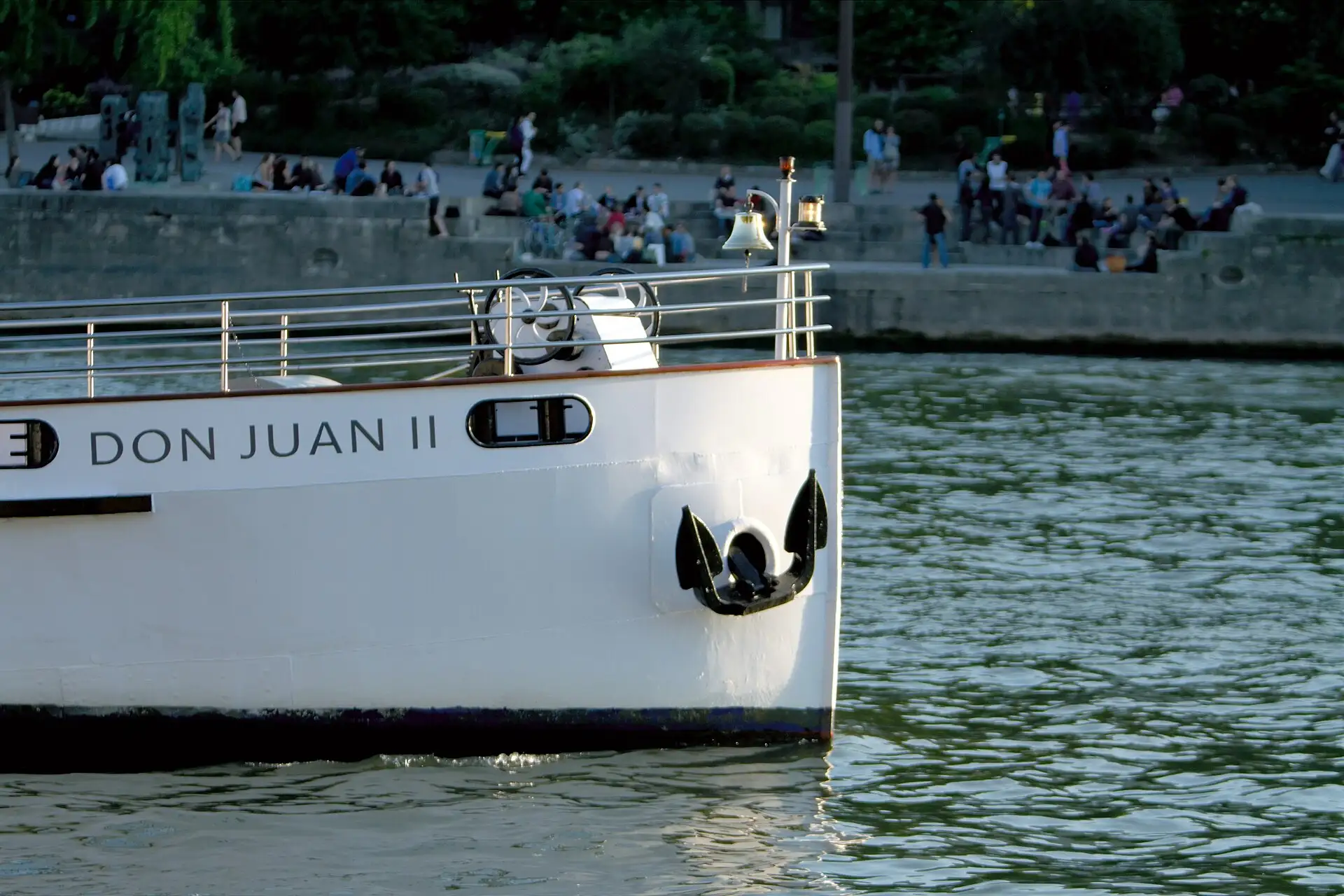
A private Seine river cruise fixes the one thing money can’t buy on the big boats: the other three hundred passengers. You charter the whole vessel — a small electric launch, a pontoon, or a yacht — with a skipper who sails when you’re ready, lingers where you ask, and keeps every seat and every photograph for your group alone. It is the difference between watching Paris from a moving grandstand and having the river briefly to yourselves.
This page explains what a charter actually includes, the boat classes and their trade-offs, how per-boat pricing works (and when it quietly becomes cheap), the proposal-and-events playbook, and the questions worth asking a skipper before you pay. Prices below are labelled approximate where they are — charter pricing moves with season, duration and hull, and the booking page for your date is the only exact number.
What a private charter actually includes
The core product is consistent across the river: a boat, a licensed skipper, and a cruise of one to two hours through the monumental heart of Paris — typically the stretch between the Eiffel Tower and Île Saint-Louis, past the Louvre, Musée d’Orsay and Notre-Dame, under Pont Neuf and Pont Alexandre III. Boarding is from central pontoons; the exact quay is on your ticket.
On top of that base, listings differ in what’s poured and what’s staged. The wine charter in the picks above includes a bottle for the group; the champagne cruise adds flutes and the option of coordinated surprises; the rosé and macarons sailing packages the golden-hour photo cruise. Some skippers narrate like guides, others stay quiet at the tiller — reviews tell you which temperament a listing has. Blankets are commonly aboard for evening sailings; ask rather than assume.
What’s not included matters equally: charters rarely include hotel transfers, extended routes beyond the central loop cost more, and the advertised duration starts at castoff, not at your arrival at the quay.
The boat classes, and who each suits
Pontoon boats. Flat, stable, open platforms with lounge-style seating — the most social layout on the water. The private guided pontoon cruise is the easy choice for families with children, older guests, and anyone who values stability and open sightlines over sleekness. Cons: no cabin, so weather is felt directly, and the aesthetic is comfortable rather than cinematic.
Small electric and classic launches. The boats you see in proposal photographs: low to the water, quiet motors, seating for a handful of guests. Electric hulls in particular sail almost silently — under the bridges you hear the city, not the engine. This class carries most wine-and-champagne listings. Cons: tight passenger limits, minimal shelter, and the least tolerance for rain.
Yachts. Enclosed salons, crew beyond the skipper, and proper dining service — the tier where a charter becomes an event venue. On the Seine this is the territory of Yachts de Paris, whose vessels handle private dinners, corporate evenings and weddings. Pricing sits far above the small-boat tier and is quoted per event; their official website carries the exact packages. If your occasion involves a seated dinner for twenty, start there, not with a pontoon.
How the pricing logic works
Charters price per boat, not per person — the single most important fact on this page, and the one that reverses most people’s assumptions. Approximate anchors: small boats start around €150–200 for a cruise, with champagne packages, longer durations and larger hulls scaling upward from there. Treat every number as a starting point and confirm on the booking page; unlike the fixed-fare big boats, charter prices genuinely move.
The arithmetic that follows from per-boat pricing:
- Two passengers pay the whole boat between them — the premium-occasion scenario, competing against a €114+ per-head dinner cruise for the same evening budget.
- Four to six passengers hit the sweet spot: per head, the charter falls toward the €30–50 range of the river’s mid formats, while beating all of them on experience.
- A full boat near its passenger limit can undercut the per-person cost of the better group formats outright — the rare case where the private option is also the economical one.
The comparison to hold in mind is not charter versus sightseeing boat (€18 wins that on price forever) but charter versus occasion spending — a tasting-menu dinner, a hired photographer, a big-boat window table for four. Framed that way, the full price ladder puts charters in surprisingly reasonable company.
Proposals, birthdays and small events
The small-boat charter is the Seine’s dedicated occasion machine, and proposals are its main trade. The pattern that works: book a champagne listing, then message the operator with the plan — skippers do this weekly and will time the key moment for the Eiffel Tower stretch, ideally during the sparkle, which runs for five minutes every hour after dark. Flowers placed aboard, a speaker for your playlist, and a skipper who quietly shoots photos at the right moment are all commonly arrangeable; several charters sell these as named add-ons at checkout.
Birthdays and anniversaries run the same playbook with less choreography. For anything bigger — a milestone dinner, a small wedding party — jump classes to the yacht tier, where catering and service are part of the vessel rather than bolted on. And if the occasion is romance without the question, the romantic cruise page compares charters against the shared formats built for two.
Bring-your-own: read before you pack
There is no river-wide rule, and this is where charters differ most. Some skippers welcome your own picnic and wine outright; some allow food but not outside alcohol; some sell fixed drinks packages and prohibit anything carried aboard. Licensing varies boat by boat, which is why the answer changes between two nearly identical listings. The policy is usually stated on the booking page — when it isn’t, message the operator before booking, and get the answer in writing inside the platform chat. Two practical constants regardless of policy: glass on a small open deck is at the skipper’s discretion, and whatever you bring, you carry down a pontoon gangway — pack accordingly.
Seasons on a small boat: when chartering is at its best
The big glassed-in ships flatten the seasons; a small open boat amplifies them, and picking the right month matters more here than anywhere else on the river.
May, June and September are the charter sweet spot: long evenings, warm air on the water, and golden-hour slots late enough that dinner beforehand is possible. This is also when demand peaks — the booking-lead advice below is written for these months.
July and August bring the warmest water-level evenings of the year and the latest sunsets, with one caveat: the riverbanks are at their most crowded, and the quays around the Eiffel Tower take longer to reach than the map suggests. Leave margin; skippers wait, but your cruise clock may not.
October through April is the contrarian’s season. The air is cold on open water — bring proper coats, not Parisian-café optimism, and confirm blankets with the skipper — but darkness falls early enough that a 17:30 charter sails the full illuminations, the river is quiet, and availability opens up even for near-term weekends. A crisp, clear December evening with the monuments floodlit and almost no boat traffic is, for photographers, arguably the best the charter format gets.
Whatever the month, the wind matters more than the temperature: a calm cold evening beats a gusty mild one on a small hull. Check the forecast the day before, use your free cancellation if the listing has it, and remember that the romantic formats page lists glassed-in alternatives for dates that can’t move.
When to book
For ordinary evenings, one to two weeks ahead is comfortable; weekday daytime slots often have near-term availability. The pressure dates are predictable: summer sunset slots (the golden-hour charters everyone wants), Saturdays year-round, Valentine’s Day, and the Christmas–New Year stretch — for these, book as early as your plans allow, a month or more for the biggest dates. Free-cancellation listings, where offered, solve the weather anxiety: lock the slot, watch the forecast, rebook if the sky turns. On small open boats that flexibility is worth more than on any glassed-in ship, because rain that a big boat ignores will genuinely change your charter.
Local tip: book the slot that ends at dusk rather than starts in darkness. You board in golden light — the photographs happen — the monuments switch their floodlights on mid-cruise, and if the tower’s sparkle lands during your Eiffel stretch you got the whole repertoire in one hire. Ask the skipper to run the Eiffel leg last; most will.
Questions to ask the skipper before you pay
- What is the certified passenger limit? It’s a legal ceiling, not a suggestion — infants count on most boats.
- What happens in rain? Rescheduling policy, covered options, whether a canopy exists.
- What exactly is included in drinks? One bottle for the group reads differently at two passengers than at ten.
- Can we bring our own food or wine, and is glass allowed?
- Which route, and can we weight it? More Eiffel Tower, or more Notre-Dame and the islands — one to two hours can’t maximise both.
- Where precisely is boarding? Get the quay name; “near the Eiffel Tower” spans four pontoons.
- For a surprise: will the crew coordinate? Timing, discretion, and who’s holding the phone camera at the moment that matters.
Good operators answer all seven without friction — the answers are the product. Build a shortlist from the picks above, sanity-check against the best cruises comparison if you’re still weighing private against shared, and then let the smallest boat you’ve ever hired show you the biggest version of Paris.
What we like
- Per-boat pricing turns 'luxury' into simple arithmetic — split four ways, it rivals two dinner-cruise seats
- The skipper adjusts the route and pace: linger at the Eiffel Tower, skip what bores you
- Small hulls sit close to the water — the photographs look nothing like big-boat shots
- Proposals, birthdays and surprises can be staged properly, with the crew in on the plan
What to watch out for
- Small open boats are exposed to rain and cold in a way glassed-in ships never are
- Inclusions, drinks rules and passenger limits vary boat to boat — every listing needs reading
- Sunset slots in summer book out a week or more ahead
- At two passengers the per-head cost is real money — the value builds with the group
Frequently asked questions
How much does a private Seine river cruise cost?
Small private boats start around €150–200 for a cruise — treat that as approximate and check the listing for your date and group size. The price is per boat, not per person, so four passengers pay a quarter each of what a couple pays. Longer routes, champagne packages and yacht-class hulls raise the total; check the current price on the booking page.
Is a private Seine cruise worth it?
Split between four or more people, genuinely — the per-head cost approaches the upper sightseeing formats while removing the crowds entirely. For couples it's an occasion purchase: you pay for privacy, a flexible route and photos with nobody else in frame. If you just want to see the monuments, the €18 sightseeing boat does that; the charter is for how the evening feels.
Can you rent a boat on the Seine for a proposal?
Yes — it's one of the most common charter bookings, and skippers on champagne cruises handle proposals routinely. Message the operator after booking to coordinate timing (most people choose the Eiffel Tower stretch, ideally at the hourly sparkle), any flowers or music, and a discreet photo plan. Book the slot one to two weeks ahead, more for summer sunsets.
How many people fit on a private Seine boat?
Small electric boats and pontoons typically carry between two and roughly a dozen passengers; the exact certified limit is listed on each booking page and skippers cannot exceed it. Larger groups move into yacht territory — Yachts de Paris-class vessels handle events and dinners at a different price tier. Count your group before shortlisting boats.
Can you bring your own food and drinks on a private cruise?
It depends entirely on the operator. Some charters welcome your own picnic and bottles, others sell fixed packages and prohibit outside alcohol, and licensing rules differ between boats. The listing usually states the policy; if it doesn't, message the operator before booking rather than assuming. Never assume glass is allowed on small open decks.
How far in advance should I book a private boat in Paris?
One to two weeks for a normal evening; earlier for the slots everyone wants — summer sunsets, Saturdays, Valentine's Day and the Christmas–New Year stretch, which can need a month or more. Weekday daytime charters often have next-day availability. Booking early also gives you time to coordinate extras with the skipper.
What is the difference between a private cruise and a luxury yacht cruise?
Class of vessel and class of service. A private cruise usually means a small open boat with a skipper and drinks — intimate, informal, from around €150–200 per boat. Yacht cruises, like those run by Yachts de Paris, add enclosed salons, crews and proper dining, at prices to match. Same river, different industries; choose by occasion and budget.